
Best Mushroom Coffee of 2026: 5 Picks Reviewed & Compared
Disclosure: This post contains affiliate links. If you buy through links on this page, we may earn a commission at no extra cost to you. Prices and ratings shown were checked at the time of writing and can change — please check the product page for the current price.
Last updated: October 21, 2026
Method: Tried it, plus label research
Regular coffee gives you energy, but for many people it also brings jitters, an afternoon crash, or an unhappy stomach. That trade-off is why mushroom coffee has grown from a niche trend into a mainstream morning routine across the USA: it blends real coffee with functional mushroom extracts, keeping the ritual and flavor of a normal cup.
Not every brand deserves your money, though. Some use meaningful amounts of fruiting-body extract and coffee you would happily drink on its own, while others sprinkle in a token amount of mushroom powder and charge premium prices for basic instant coffee with good marketing. If mushroom coffee reviews have left you more confused than confident, this Ayklen guide will make the choice simple.
I judged every product on the same criteria: taste; the mushrooms themselves — fruiting body vs. mycelium, species, and dose per serving; coffee quality and origin; trust signals such as organic certification and third-party testing; and value for money. Here are the five picks that came out on top.
How I tested
I bought all five myself and drank each one for about a week, hot, with milk or sweetener, in the morning and in the evening. I paid attention to two things: how it tasted and how it sat with my stomach. I didn’t measure energy or focus, so I’m not making claims about either. Everything else (ingredients, caffeine, price) comes from the labels and product pages.
I compared these five mushroom coffees by drinking each one for about a week, and checked them against the details brands publish themselves — mushroom species and dose per serving, caffeine per cup, format, sweeteners and cost per serving — plus each brand’s published third-party testing information. I did not run lab tests, and prices change often. Where a brand doesn’t publish a number, I say so instead of guessing.
Ayklen Picks: The Best Mushroom Coffee at a Glance
| Product | Best For | Format | Approx. Price |
|---|---|---|---|
| RYZE Mushroom Coffee | Best Overall | Instant powder | ~$45/30 servings |
| Four Sigmatic Focus Ground Coffee | Best for specialty coffee drinkers | Ground | ~$22/12 oz |
| Everyday Dose Coffee+ | Best for low-caffeine / sensitive buyers | Instant | ~$45/30 servings |
| Laird Superfood Mushroom Coffee | Best Three-Mushroom Ground Coffee | Ground | ~$20–25/12 oz |
| La Republica Organic Mushroom Coffee | Best value on Amazon | Instant | ~$20–25/35 servings |
Prices checked October 2026 — check Amazon for the current price before you buy.
All five tasted good to me and none upset my stomach, so these scores come down to which ones I enjoyed most and would actually want again.
| Product | My score /10 | Would buy again? | Taste in a few words |
|---|---|---|---|
| RYZE Mushroom Coffee | 9 | Yes | Smooth and earthy, with a mild nutty flavor |
| Four Sigmatic Focus Ground Coffee | 8 | Yes | Most like regular coffee — rich, dark, roasted, slightly chocolatey |
| La Republica Organic Mushroom Coffee | 7.3 | Yes | Rich and earthy, roasted notes, slightly woody finish |
| Everyday Dose Coffee+ | 6.5 | No | Mild, smooth and a little creamy |
| Laird Superfood Mushroom Coffee | 6.5 | No | Familiar medium roast — toasted and earthy |
The numbered order follows each product’s category; the table shows my overall scores.
Scores are my overall impression after about a week with each product, based mainly on taste and how it sat with my stomach. They are not lab measurements.
1. RYZE Mushroom Coffee — Best Mushroom Coffee for Gut Health
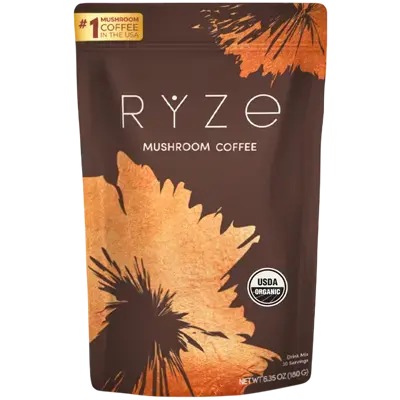 |
RYZE Mushroom CoffeeBest for Gut Health | USDA Organic ~$45 / 30 servings
|
RYZE is the name most people meet first in this category, and its formula explains much of that popularity. Each serving packs six mushrooms — Cordyceps, Lion’s Mane, Reishi, Shiitake, Turkey Tail and King Trumpet — at a stated 2,000 mg, alongside MCT and prebiotic fiber, which is why it is my top pick overall, with a formula built around prebiotic fiber, MCT and six mushrooms. Its caffeine is modest, at about 48 mg per serving. It is also USDA Organic.
My take: RYZE got my highest score. It’s smooth and earthy with a mild nutty flavor, and it’s less like a strong cup of coffee. The mushroom notes may take some getting used to. My stomach was fine all week, and I’d buy it again.
| Format | Instant powder |
| Mushrooms | 6 mushrooms incl. Cordyceps, Reishi, Turkey Tail — 2,000 mg/serving |
| Coffee Base | Instant coffee + MCT + prebiotic fiber |
| Caffeine | ~48 mg per serving |
| Price (approx.) | ~$45/30 servings |
Pros
- ✅ Six mushrooms, stated 2,000 mg dose
- ✅ Prebiotic fiber + MCT
- ✅ Lower caffeine (~48 mg)
- ✅ USDA Organic
Cons
- ❌ Too mild/earthy for some
- ❌ About $1.50 per serving
Bottom line: Choose RYZE if mushroom variety and a gentle, mild cup beat bold coffee taste.
2. Four Sigmatic Focus Ground Coffee — Best for Specialty Coffee Drinkers
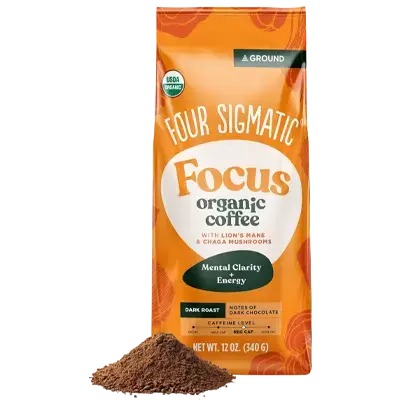 |
Four Sigmatic Focus Ground CoffeeBest for Specialty Coffee Drinkers ~$22 / 12 oz bag
|
Four Sigmatic helped invent this category, and Focus is aimed at people who take their beans seriously. The base is a dark roast of single-origin Arabica from Honduras. Each serving adds 250 mg of Lion’s Mane and 250 mg of Chaga, both from fruiting body extract — where the most studied compounds are concentrated. The dose is more modest than some rivals, so treat this as a coffee-first product. At roughly $22 for a 12 oz bag, it is also an affordable way to test the category.
My take: This one tastes the most like regular coffee. It’s richer and darker, with roasted, slightly chocolatey notes, closer to a dark roast than a typical mushroom blend. No stomach trouble, and I’d buy it again.
| Format | Ground, dark roast |
| Mushrooms | Lion’s Mane 250 mg + Chaga 250 mg (fruiting body) |
| Coffee Base | Single-origin Honduras Arabica |
| Caffeine | Full-strength range |
| Price (approx.) | ~$22/12 oz |
Pros
- ✅ True specialty dark roast
- ✅ Fruiting body, clearly dosed
- ✅ Affordable first try
- ✅ Widely stocked brand
Cons
- ❌ Lower mushroom dose
- ❌ Too bold for some palates
Bottom line: Best for health-conscious drinkers who still want a proper specialty brew.
3. Everyday Dose Coffee+ — Best Low-Caffeine for Sensitive Buyers
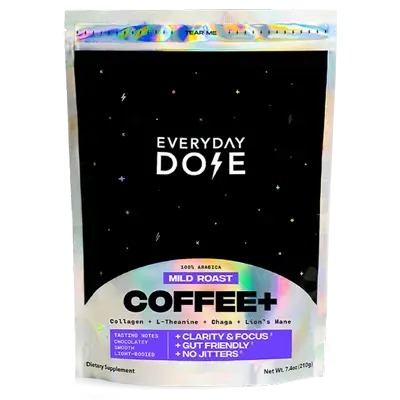 |
Everyday Dose Coffee+Best Low-Caffeine ~$45 / 30 servings
|
Everyday Dose is the low-caffeine option here. It has roughly 45 mg of caffeine — less than half of a typical coffee — plus L-Theanine, an amino acid commonly paired with caffeine in blends like this. The functional side is substantial too: 1,500 mg of Lion’s Mane and Chaga fruiting body extract, plus 4 grams of collagen per serving. That collagen means it is not vegan.
My take: Mild, smooth and a little creamy, with subtle coffee and chocolate notes. If you like a strong, bold brew, it may feel too mellow. No stomach issues, but it isn’t one I’d reorder.
| Format | Instant |
| Mushrooms | Lion’s Mane + Chaga (fruiting body), 1,500 mg; collagen 4 g; L-Theanine |
| Coffee Base | Instant coffee |
| Caffeine | ~45 mg per serving |
| Price (approx.) | ~$45/30 servings |
Pros
- ✅ Low caffeine + L-Theanine
- ✅ 1,500 mg fruiting-body dose
- ✅ Collagen built in
- ✅ Instant — no brewing needed
Cons
- ❌ Not vegan (collagen)
- ❌ Weak if you want a strong kick
Bottom line: Best for low-caffeine, all-in-one morning routines.
4. Laird Superfood Mushroom Coffee — Best Three-Mushroom Ground Coffee
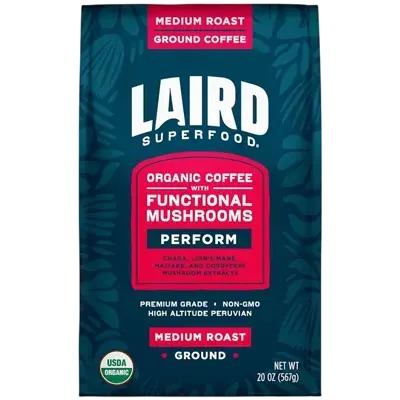 |
Laird Superfood Mushroom CoffeeBest Three-Mushroom Ground Coffee ~$20–25 / 12 oz bag
|
Most mushroom coffees stop at fungi, but Laird Superfood widens the formula. Alongside Lion’s Mane and Chaga, it adds Cordyceps, a third functional mushroom. The coffee is a medium roast Peruvian Arabica, and it brews like the ground coffee you already buy. If you want three functional mushrooms in a familiar bag of ground coffee, this is the natural choice.
My take: It tastes like a familiar medium-roast, toasted and earthy, closer to regular brewed coffee than a sweet instant drink. It takes a bit more effort to prepare. No stomach issues, but I wouldn’t buy it again.
| Format | Ground, medium roast |
| Mushrooms | Lion’s Mane + Chaga, plus Cordyceps |
| Coffee Base | Peruvian Arabica |
| Caffeine | Standard ground-coffee range |
| Price (approx.) | ~$20–25/12 oz |
Pros
- ✅ Cordyceps adds mushroom variety
- ✅ Balanced Peruvian medium roast
- ✅ Lower price per bag
- ✅ Easy to find in the US
Cons
- ❌ Mushroom dose less prominent
- ❌ Ground only, no instant
Bottom line: A fit if you want three functional mushrooms in a ground coffee.
5. La Republica Organic Mushroom Coffee — Best Value on Amazon
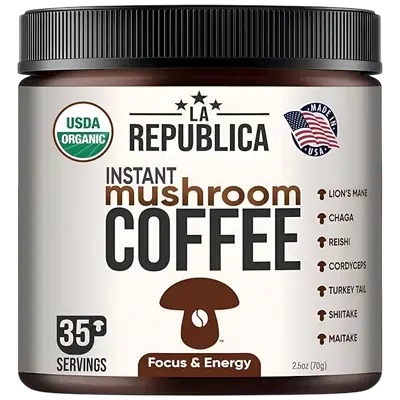 |
La Republica Organic Mushroom CoffeeBest Value on Amazon ~$20–25 / 35 servings
|
If you want organic, unsweetened and affordable, La Republica is the pick. At about $0.71 per serving it is one of the most affordable ways into mushroom coffee, and its seven-mushroom blend is the broadest here. The trade-off: it is instant-only. It has no added sweeteners, and at this price it is a multi-mushroom instant that is easy to order on Amazon. As a low-risk step into the best mushroom coffee 2026 conversation, the math is hard to argue with.
My take: Rich and earthy, with roasted notes and a slightly woody finish. It’s an easy instant option, though the mushroom blend may not suit everyone’s taste. No stomach issues, and I’d buy it again.
| Format | Instant |
| Mushrooms | 7-mushroom blend |
| Coffee Base | Instant coffee |
| Caffeine | About 80 mg per serving, per the brand’s website |
| Price (approx.) | ~$20–25/35 servings (~$0.60/cup) |
Pros
- ✅ Lowest cost per cup
- ✅ USDA Organic
- ✅ Easy Amazon reordering
- ✅ Low-risk first try
Cons
- ❌ Mushroom blend may not suit every taste
- ❌ No extras like collagen
Bottom line: Best value on Amazon for budget-conscious beginners.
How to Choose the Best Mushroom Coffee
These five criteria separate the best mushroom coffee for health and taste from the rest of the shelf.
1. Start With Taste and Coffee Quality
A functional drink only works if you actually drink it. Look for named bean origins, a stated roast level, and a high Arabica content. Vague “coffee blend” labels often hide lower-grade beans.
2. Check Fruiting Body vs. Mycelium
The most important label detail. The fruiting body is the actual mushroom cap, where beta-glucans and other studied compounds are concentrated. Cheaper products may use mycelium grown on grain, meaning a large share of the powder can be starchy grain. Brands that state “fruiting body” and a milligram dose are being transparent — reward that.
3. Look at the Mushroom Dose and Species
A meaningful formula names its species and quantities, from a few hundred milligrams up to around 2,000 mg per serving. A long ingredient list with no amounts is a red flag.
4. Value Certifications and Third-Party Testing
USDA Organic, non-GMO verification, and third-party testing for heavy metals and potency signal real quality control. Mushrooms absorb compounds from their growing environment, so testing matters more here than in ordinary coffee.
5. Do the Monthly Math
Compare cost per serving, not bag price: a $45, 30-serving product is about $1.50 a day, while value instants can approach $0.60 a cup. Try a single order before subscribing.
6. Instant vs. Ground: Pick Your Format
Three of the five picks (RYZE, Everyday Dose and La Republica) are instant: the powder dissolves in hot water, which is the fastest way to make them and easy to travel with. Two (Four Sigmatic and Laird) are ground coffee that brews in a normal machine or French press, so you control the strength and keep the usual coffee ritual. Neither format is better in itself — it depends on how you like to make your coffee — but check the format before you buy, because an instant powder will not work in your coffee machine.
Know Your Mushrooms: A Quick Ingredients Guide
Lion’s Mane
Lion’s Mane is the mushroom most closely associated with focus and mental clarity, and it headlines most focus-oriented coffees. It has a long history in East Asian culinary and herbal traditions, and research into its compounds is active but still preliminary. Most people choose it hoping for a clear-headed, productive feel alongside their caffeine.
Chaga
Chaga grows mainly on birch trees in cold climates and has been brewed as a tea in northern regions for generations. It is rich in naturally occurring antioxidants, with a deep, earthy character that blends comfortably with coffee’s roasted notes. It is most often associated with everyday immune support and general wellness, though strong health conclusions are not established.
Cordyceps, Reishi and Turkey Tail
Cordyceps is traditionally used by active people and associated with energy and stamina routines. Reishi, sometimes called the “mushroom of calm,” has a long traditional history in balance-focused formulas. Turkey Tail is one of the most researched mushrooms for its polysaccharides and is commonly associated with immune and gut-related wellness. The honest summary for all three: promising traditions and early research — ingredients in a healthy routine, not medicines.
Is Mushroom Coffee Safe? What to Know Before You Sip
For most healthy adults, mushroom coffee is generally well tolerated, and many blends contain less caffeine than standard coffee. But “natural” does not mean right for everyone: functional mushrooms can interact with certain medications, including blood thinners and immunosuppressants, and some people notice mild digestive upset at first. If you are pregnant, nursing, managing a medical condition, or taking prescription medication, talk to your doctor first, and start with a half serving.
If you have a kidney condition, or a history of kidney stones, take extra care. Some functional mushrooms are naturally high in oxalates — chaga is the best-documented example, and a published case report links years of heavy daily chaga intake to oxalate kidney damage. Four Sigmatic Focus includes chaga among its extracts. The reported case involved large daily amounts of chaga powder for about five years, a very different pattern from a daily coffee, but if your kidneys are a concern, ask your doctor before making any mushroom coffee a habit.
If you are allergic to mushrooms, these coffees are not for you. Allergic reactions are also among the side effects reported in studies of lion’s mane supplements, so if you notice itching, a rash or swelling after drinking one, stop and speak to a doctor.
Caffeine sensitivity is the most common everyday issue. Even the lowest-caffeine blends above still contain caffeine, and the FDA notes that how much is ‘too much’ varies from person to person depending on body weight, medications and medical conditions. If caffeine tends to keep you awake or make you jittery, choose one of the lower-caffeine picks and keep it to the morning.
Disclaimer: This article is for general information only and is not medical advice. The statements about mushroom ingredients have not been evaluated by the Food and Drug Administration, and these products are not intended to diagnose, treat, cure, or prevent any disease. Individual experiences vary.
Which Mushroom Coffee Is the Best for You?
| Your Priority | Best Pick | Why |
|---|---|---|
| Best Overall | RYZE | Fiber, MCT, six mushrooms |
| Specialty coffee taste | Four Sigmatic Focus | Single-origin dark roast |
| Low caffeine | Everyday Dose Coffee+ | ~45 mg caffeine + collagen |
| Other added ingredients | Laird Superfood | None listed |
| Lowest budget | La Republica Organic | Organic instant, ~$0.60/cup |
Sorted by Format and Caffeine
If you would rather choose by format and caffeine, here are the same five picks sorted that way, with the score I gave each one:
| If you want… | Pick | Format | Caffeine (per brand) | My score |
|---|---|---|---|---|
| The lowest caffeine | Everyday Dose Coffee+ | Instant | 45 mg | 6.5/10 |
| Low caffeine, broad blend | RYZE | Instant | ~48 mg | 9/10 |
| The broadest blend (7 mushrooms) | La Republica | Instant | About 80 mg | 7.3/10 |
| A proper ground brew | Four Sigmatic Focus | Ground | ~150 mg | 8/10 |
| Ground, with Cordyceps | Laird Superfood | Ground | Check the label | 6.5/10 |
Figures are per serving as stated by each brand; check the label on your bag.
Frequently Asked Questions
Does mushroom coffee actually taste like mushrooms?
Mostly no. Four Sigmatic and Laird tasted like regular coffee to me, while RYZE and La Republica are earthier, and the mushroom notes may take some getting used to. I used milk or sweetener with all of them.
Is RYZE the best mushroom coffee?
In my testing, yes — RYZE is my #1 overall pick for 2026, thanks to its prebiotic fiber, MCT and six-mushroom, 2,000 mg formula. But “best” still depends on your goal: ground-coffee drinkers will likely prefer Four Sigmatic, and low-caffeine drinkers may do better with Everyday Dose. RYZE earns its fame, but no single coffee wins for every palate.
How much caffeine is in mushroom coffee?
It varies by format. Full-strength ground mushroom coffees sit in the same general range as regular coffee, while lighter instants are often around 45–48 mg per serving — roughly half a typical cup, as with Everyday Dose and RYZE. Always check the label.
What is the difference between fruiting body and mycelium?
The fruiting body is the visible mushroom — cap and stem — with the highest concentration of beta-glucans and active compounds. Mycelium is the root-like network, and when grown on grain and harvested with it, the powder can contain significant grain starch. Fruiting-body extracts with a stated dose are the higher-quality, more transparent choice.
Is mushroom coffee safe to drink every day?
Most healthy adults drink it daily without issues. Still, start with a smaller serving, and speak with a healthcare professional first if you are pregnant, nursing, immunocompromised, or taking medication mushrooms could interact with.
Which mushroom coffee is best for gut health?
All five were fine on my stomach — none of them upset it during my week with each. If stomach comfort is your main concern, RYZE is the one most built for it on paper: prebiotic fiber, MCT and Turkey Tail among its six mushrooms, with modest caffeine at about 48 mg.
Is mushroom coffee safe during pregnancy or breastfeeding?
There is not enough research on mushroom coffees during pregnancy or breastfeeding to call them safe, and these drinks still contain caffeine. The FDA advises talking to your health care provider about caffeine if you are pregnant, trying to become pregnant, or breastfeeding — so check with your doctor before drinking mushroom coffee in that situation.
Can I drink mushroom coffee if I take prescription medication?
Check with your doctor or pharmacist first. Reviews of medicinal mushrooms note that mushroom compounds may affect how the body processes some medicines, and that this matters most for medicines with a narrow safety margin, including blood thinners (anticoagulants) and immunosuppressants. A short conversation before you start is the safe move.
Does mushroom coffee have less caffeine than regular coffee?
It depends on the blend. A typical 8 oz cup of brewed coffee has roughly 80 to 100 mg of caffeine. Of the five I tested, Everyday Dose (45 mg in the Mild Roast) and RYZE (about 48 mg) are genuinely lower, at roughly half a regular cup. Four Sigmatic Focus is about 150 mg per 12 oz cup, which is in the range of regular brewed coffee, so it is not a low-caffeine option. La Republica is about 80 mg per serving, per the brand’s website. For Laird, check the label of the exact bag you are buying.
Is instant or ground mushroom coffee better?
Neither is better for everyone — it is about how you like to make coffee. Instant blends (RYZE, Everyday Dose, La Republica) dissolve in hot water and are the fastest option. Ground blends (Four Sigmatic, Laird) brew in a normal coffee maker or French press and let you control the strength. I scored these five on taste and stomach comfort, not on format.
Are the mushrooms in these coffees fruiting body or mycelium?
It varies by brand, and labels do not always say. The part used matters, because beta-glucan levels differ between the fruiting body and the mycelium in studied mushrooms. Some brands publish third-party test results that say which part they use, so check the brand’s own testing information before you buy.
Final Verdict: The Best Mushroom Coffee to Buy in 2026
So, which mushroom coffee is the best overall? After comparing taste, mushroom quality, dosing transparency, certifications and price across all five products, I give the top spot for 2026 to RYZE Mushroom Coffee. It offers the broadest formula here — six mushrooms at a stated 2,000 mg per serving, plus MCT and prebiotic fiber — in a USDA Organic instant with a gentle 48 mg of caffeine, which is why it is my best overall pick. Prefer a true specialty brew? Choose Four Sigmatic. Need the lowest caffeine? Choose Everyday Dose. Watching the budget? La Republica starts at about sixty cents a cup. Whichever you pick, buy a single pack first and give it two honest weeks in your routine.
| My #1 Pick: RYZE Mushroom CoffeeBest Overall & Best for Gut Health | USDA Organic ~$45 / 30 servings
|
Sources
Key background and safety points in this guide draw on the following published sources, alongside my own testing:
- U.S. Food and Drug Administration — “Spilling the Beans: How Much Caffeine is Too Much?”
- Lee S, et al. — “Development of End Stage Renal Disease after Long-Term Ingestion of Chaga Mushroom: Case Report and Review of Literature.” Journal of Korean Medical Science, 2020.
- Kirdeeva Y, et al. — “The Inclusion of Dietary and Medicinal Mushrooms into Translational Oncology: Pros and Cons at the Molecular Level.” International Journal of Molecular Sciences, 2026.
- Menon A, et al. — “Benefits, side effects, and uses of Hericium erinaceus as a supplement: a systematic review.” Frontiers in Nutrition, 2025.
- Vetter J. — “The Mushroom Glucans: Molecules of High Biological and Medicinal Importance.” Foods, 2023.
Uzma writes and edits the buying guides at Ayklen. For this guide, she bought and tried all five products herself and combined her tasting notes with research into ingredients, caffeine content and price.
Tried any of these? Share your experience in the comments, and bookmark this Ayklen guide — I update my picks as new products land.
